
Introduction
Research on educational technology suggests that not all digital math tools support learning in the same way. Tools that are adaptive, interactive, and aligned with the curriculum outcomes tend to be most effective for supporting differentiation in elementary classrooms. Programs such as Khan Academy (including Khan Academy Kids), DreamBox, Prodigy, and ScratchJr each support mathematical learning in different but complementary ways.
Khan Academy (Khan Academy Kids)
Khan Academy and Khan Academy Kids provide mastery-based learning experiences that allow students to progress at their own pace. These platforms offer instructional videos, interactive practice, end-of-unit quizzes, and immediate feedback.
Khan Academy Kids, in particular, is designed to support younger learners (K-2) and includes visuals, audio support, and scaffolded activities that promote early numeracy and accessibility. Research on mastery-based digital learning suggests that allowing students to revisit concepts and receive immediate feedback can support confidence and long-term skill development.
DreamBox Learning
DreamBox Learning is an adaptive math program that focuses on conceptual understanding. Unlike programs that only adjust difficulty, DreamBox analyzes how students solve problems and adapts instruction in real time based on their strategies, accuracy, and pacing. This allows students to explore mathematical concepts using visual models and multiple representations, which is particularly beneficial for concrete visual learners. Research on DreamBox suggests that consistent use can support improvements in mathematical learning and understanding, especially in elementary and middle school grades.
Prodigy Math
Prodigy Math is a game-based learning platform designed to increase students’ motivation while providing adaptive math practice. Its game-based learning structure encourages engagement, particularly for students who are anxious or disengaged during traditional math activities. Prodigy is another math program that adjusts questions based on student responses and provides immediate feedback, allowing learners to work at an appropriate level while still reinforcing core math skills. Research and classroom use suggest that this type of adaptive practice can support skill development while maintaining high levels of student engagement.
ScratchJr
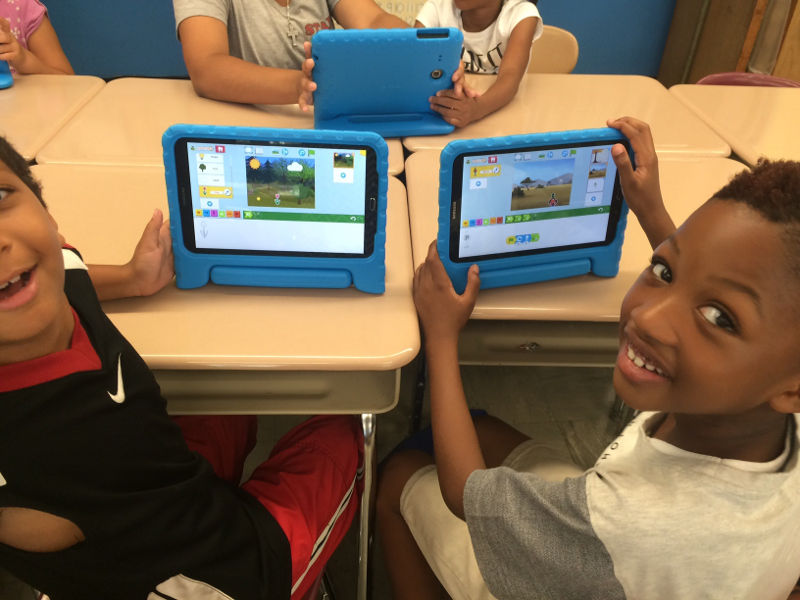
Although ScratchJr is not a traditional math program, research highlights its role in developing foundational skills related to mathematical thinking. ScratchJr supports computational thinking, sequencing, pattern recognition, and problem solving, which are all closely connected to mathematical learning. By creating stories and animations through block-based coding, students practice logical reasoning and step-by-step thinking in a highly engaging and creative way.
Final Thoughts
Overall, I really enjoyed researching and testing out these different educational technology platforms. I believe that when teachers and students learn how to use each program it can support differentiation. I really enjoyed seeing how the tools adjusted difficulty, offered different forms of representation, and were implemented in a way that can make learning more engaging and interactive. I believe that each tool supports different aspects of math learning, reinforcing the idea that technology is more affective when you use it thoughtfully and take the time to learn how to use the platform. When this is done, this is when technology can meet diverse learner needs.
Sorry, but comments are not enabled on this site.